




For more than a decade, speed of alerting has been treated as the defining capability of open-source intelligence platforms supporting intelligence and security missions. The ability to surface breaking events from news, social media, and other open sources in near real time was once transformative. Today, it is expected.
If a modern intelligence platform cannot rapidly notify analysts of emerging incidents, it does not belong in operations. Speed enables awareness. But awareness alone does not create decision advantage. In increasingly complex operating environments, the real value of intelligence begins after the first alert fires.
Beyond the First Alert
This image, which captures the evolution of nationwide protests in Iran over time, illustrates this challenge clearly. The initial signal—that protests had begun—was important but fleeting. What followed mattered far more: how unrest spread across cities and provinces, how protest intensity changed, how security forces responded, and how sentiment and violence evolved over days and weeks.
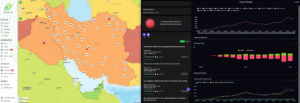
These dynamics, not the first notification, determined the strategic significance of the event. For analysts and decision-makers, understanding whether unrest is localized or nationwide, escalating or stabilizing, and symbolic or structurally destabilizing is what informs posture, resourcing, and response.
Alert-centric tools are optimized to answer one question well: What just happened? Intelligence and Security missions, however, demand answers to harder questions: What does this mean? What is likely to happen next? And how does this affect broader operational, regional, or strategic outcomes?
Anticipation Over Reaction
The first capability required to close this gap is anticipation. Rather than waiting for an event to cross a visibility threshold, intelligence systems must help identify underlying pressure points—economic stress, political instability, governance failures, social sentiment shifts, or changes in security force posture—that indicate disruption is becoming more likely.
Anticipatory insight allows leaders to prepare, posture resources, engage partners, and shape response options before crises fully materialize. It does not replace traditional indications and warnings; it modernizes them by applying machine-scale analysis across vast volumes of open data, while still grounding assessments in analytic tradecraft.
Anticipation shifts intelligence from reactive reporting to proactive risk management.
Tracking Event Evolution and Impact
The second capability is event evolution and impact assessment. Once an event occurs, the mission is not complete. Analysts must continuously track how it develops, distinguish signal from noise, and understand second- and third-order effects.
In the case of the Iran protests, this means monitoring geographic spread, escalation or de-escalation patterns, changes in state response, and downstream impacts on regional stability, diplomatic posture, economic risk, or security conditions. It also means recognizing when an event transitions. From protest to crackdown, or from domestic unrest to wider international concern.
This kind of persistent understanding cannot be achieved through static alerts or isolated reports. It requires continuous analysis that updates as conditions change and as new information becomes available.
Human–AI Teaming as the Core Model
Neither anticipation nor evolution tracking can be solved by automation alone. Artificial intelligence excels at ingesting massive volumes of data, identifying patterns, clustering related events, and highlighting anomalies at machine speed. Human analysts provide context, judgment, domain expertise, and mission understanding that algorithms cannot.
The most effective intelligence systems deliberately combine both. AI handles scale, speed, and pattern recognition. Humans validate, enrich, and contextualize the outputs. They ensure assessments are credible, relevant, and aligned to mission needs.
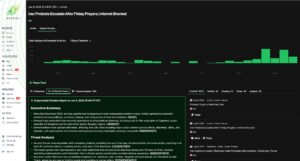
This human–AI partnership is what transforms raw data and alerts into actionable intelligence.
Dynamic Exploration Through Natural Language
A critical evolution in this model is the emergence of analyst-assistant capabilities that allow users to dynamically explore complex issues through natural language interaction. Rather than navigating rigid workflows, filters, or dashboards, analysts can ask questions in plain language and receive synthesized responses grounded in the full corpus of available data.
This approach enables a more intuitive and iterative form of analysis. An analyst tracking unrest can ask how protests have evolved over the past week, which regions are experiencing escalation, how sentiment is shifting, or what comparable historical cases reveal about likely trajectories. Each question builds on the last, allowing analysts to test hypotheses, explore alternatives, and refine understanding in real time.
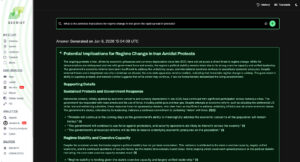
Importantly, these systems do not generate answers in isolation. They retrieve, summarize, and contextualize information from trusted data sources, presenting findings in a way that supports analytic reasoning rather than replacing it. The result is an assistant that accelerates sensemaking while keeping the analyst firmly in the loop.
From Awareness to Decision Advantage
For organizations evaluating intelligence platforms, the distinction is critical. Speed of alerting is necessary, but it is not sufficient. The platforms that deliver real mission value are those that move beyond notifications to provide persistent understanding allowing an analyst to anticipate disruption, track how events evolve, and assess their impact across local, regional, and global scales.
Alerts tell you that something happened. Intelligence tells you what it means, what’s next, and how to act.
In today’s operating environment, that difference defines decision advantage.