





Terrorism Outlook in Q2 2026
Mar 27, 2026
Security, Terrorism
Analysis Details
- The US and Israeli war with Iran has increased threat actors’ intent to target Jewish, Israeli and US interests, including individuals and religious or cultural sites.
- A surge in global terrorism incidents recorded by Seerist in March has been driven by a rise in attacks by Iran-aligned, Lebanese Shia movement Hizbullah on Israeli military targets and urban centres.
- Radicalised individuals, connected to Islamic State (IS) or sympathetic to Iran, pose the main threat in Western countries. Fringe pro-Palestinian and anti-war groups in Europe may also have increased intent to target governments and businesses linked to Israel and the US, especially those in the technology and defence sectors.
- Extremist threats are likely to increase around the Jewish Passover (Pesach) holiday (1-9 April) and the Christian Easter holiday (2-5 April), prompting enhanced security around religious schools and places of worship.
Concentrated response
Global terrorism incidents recorded by Seerist have seen a marked increase since US and Israeli strikes in Iran on 28 February. Between 28 February and 17 March, there were 300 Islamist extremist incidents, representing a 215% rise compared with the previous 18 days. The increase is directly linked to Hizbullah targeting Israel and Israel Defense Forces (IDF) military assets within Lebanon.
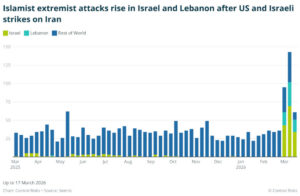
Prior to the Iran conflict, sub-Saharan Africa remained the hotspot for global extremist incidents recorded by Seerist, followed by the Middle East and North Africa, and distantly by the Americas, Europe and Asia.
Increased intent
The global terrorism threat level has been higher in the past few years because of ongoing instability in the Middle East. However, the conflict between the US, Israel and Iran has increased threat actors’ intent to target Jewish, Israeli and US assets, such as synagogues, schools, businesses, diplomatic facilities and cultural sites.
The US Department of State on 22 March issued a global advisory to US citizens about the threat from “groups supportive of Iran [that] may target other US interests overseas or locations associated with the US and/or Americans throughout the world”. In Iraq, a hotel known to be frequented by foreigners in Erbil on 6 March was hit with debris from intercepted drones launched by Iran-backed Iraqi militias. US diplomatic facilities were also targeted in Norway and Iraq.
Diversity of threats
Radicalised individuals – particularly those linked to IS or individuals sympathetic to, but not officially associated with, the Iranian government – will remain the most significant threat actor in Western countries. In France, counter-terrorism officials on 10 March arrested two men on suspicion of plotting a “deadly and antisemitic” attack. They were in possession of a semi-automatic weapon, a bottle of hydrochloric acid, aluminium foil and an IS flag.
Iran is likely to focus on asymmetric kinetic and cyber tactics, using its existing networks to target Iranian dissidents and, increasingly, Jewish and Israeli communities in Western countries, especially Europe. Arson is a favoured tactic of such perpetrators, but they are also likely to carry out other low-sophistication attacks such as knife attacks. Sophisticated, co-ordinated attacks by Iran-affiliated actors are more likely to be thwarted, as planning for such attacks will leave a digital trail, drawing intelligence services’ attention.
A previously unknown group that is suspected to have links to Iran, Harakat Ashab al-Yamin al-Islamia (HAYI), has claimed most of the recent attacks in the UK, Belgium, Greece and the Netherlands. CBS News (US) has reported that the group on 23 March repeated its threat against “US and Israeli interests worldwide” in response to ongoing Middle East conflicts. European media outlet Euractiv on 24 March reported that initial posts by HAYI originated from Telegram accounts affiliated with Hizbullah, increasing the possibility of HAYI’s connection to Iran.
Fringe anti-war activists or state-sponsored groups will also have increased intent to target private companies associated with Israel and the US, especially defence and technology companies. These groups will likely opt for sabotage tactics, such as arson or vandalism. Czech and Slovak police on 24 March arrested US and Czech citizens on terrorism charges following an arson attack on 20 March targeting a weapons manufacturer in Pardubice (Czechia). Activists motivated by the conflict in the Middle East or state actor-linked operators are the most likely perpetrators in this incident.
Religious holidays
Extremist threats are likely to increase around the Jewish Passover (Pesach) holiday (1-9 April), and during the Christian Easter holiday in early April. A gathering in Australia in December 2025 to celebrate the Jewish festival of Hanukkah was the target of a mass shooting by two men linked to IS.
There has been a spate of arson and explosive attacks against Jewish schools and places of worship including in Canada, the Netherlands, the UK, Greece and Belgium. A man armed with a rifle crashed a vehicle into a synagogue, which immediately caught fire, near the city of Detroit (US) on 12 March. Several members of the attacker’s family were reportedly killed in Lebanon in a recent Israeli attack. Italy, Belgium, the UK and the Netherlands have announced increased patrols and security presence in high-profile locations, including the Jewish Quarter in Rome and 20 synagogues across Belgium and four schools in Antwerp.
Sources:
“Group claiming Europe antisemitic attacks tells CBS News it will target “U.S. and Israeli interests worldwide””, CBS News
“Iran-Backed Iraqi Militias Target Iraqi Kurdistan’s Hotels With Drones”, Forbes
“European officials investigate possible Hezbollah links to antisemitic attack wave”, Euractiv
“Two brothers arrested in France over ‘deadly and antisemitic’ plot, anti-terror prosecutors say”, Le Monde
“Arsonists from Pardubice threaten arms manufacturers, police charge three detainees with terrorism”, Aktualne
“Soldiers to provide security for Belgian synagogues and Jewish schools”, VRT
Control Risks