





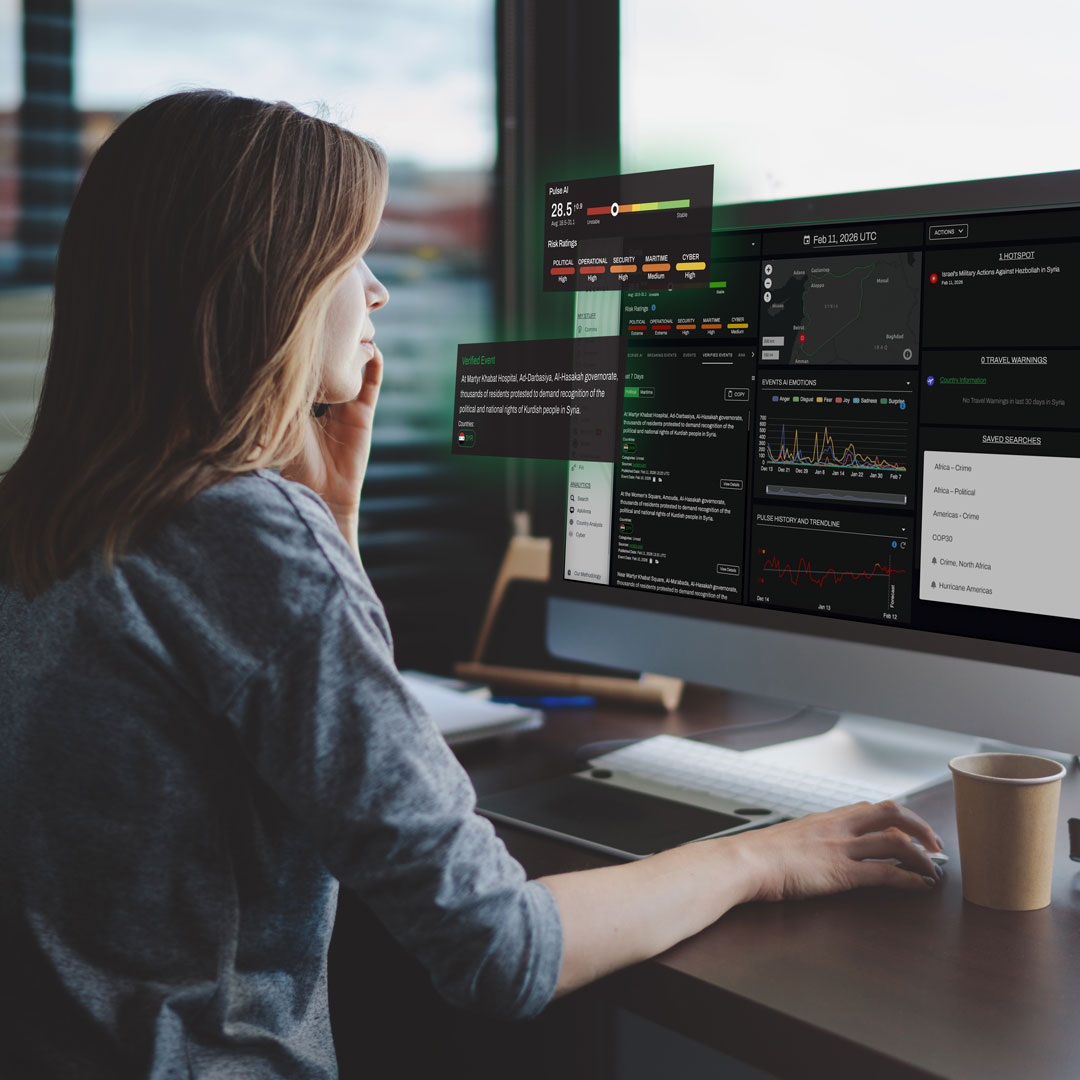
For years, we’ve graded enterprise risk tools by how well they can chart an organization’s basic vulnerability to geopolitical, operational, and physical threats. Their lingua franca has traditionally been dominated by a hodgepodge of spreadsheets, dashboards, and flashy, color-dotted maps purpose-built to address one fundamental question: “Where and how are we exposed?”
For modern analysts tasked with holistically safeguarding organizations in a complex, hyperconnected global environment, the legacy toolkit leaves us wanting. It’s increasingly evident that tools primarily tuned to addressing the basic exposure question just aren’t keeping up with real-world demands.
What we really need here is a tech-enabled risk management continuum that gets us from exposure to vulnerability to impact to decision. Along the way we should be building layers of context around: “Where are we?” “What could happen there?” “How much would it matter if it did?”
Target Trajectory:

- Exposure: What risk signals exist?
- Vulnerability: What assets, processes, or dependencies could fail?
- Impact: How would failure affect revenue, people, operations, or brand?
- Decision: What action is required, by whom, and when?
To get there, analysts and operators require solutions that can help them efficiently and effectively come to grips with the nature of their role – assessing impact. That’s where most current tools leave risk teams wanting.
The truth is, however, most risk technologies were built for visibility, not assessment. They collect and display exposure data but fail to guide analysts through an efficient reasoning process to determine business impact. Today’s risk tech tools help analysts see more, not see better. They deliver proximity data but leave the hard work of understanding real impact entirely to human judgment.
That means for most organizations, the analytical process that turns signals into decisions still happens in a meeting room, not inside software. Stitching together the two key risk domains of external intelligence and internal impact remains inefficient, with substantive burden placed on both users and on the patchwork of systems their tools create. Analysts, armed with inelegant, form-based processes are left on their own to contend with the critically important impact-centric portion of the risk equation.
As our industry and our methodologies mature toward increasingly granular impact-based analysis, global enterprises are discovering that an advanced approach to risk resilience and decision-making is not just an analytical transmutation; it’s technological as well. The focus on impact needs to be better supported by the tools in every analyst’s arsenal.
Why Impact Focus Matters
Impact-based risk assessments are grounded in a perspective that’s far broader than the narrow exposure lens most of today’s risk solutions were fine-tuned for. Here we’re asking, “What are the consequences if a risk materializes?” We’re focused on weighing severity and relevance, not just proximity. Rather than simply mapping exposures, the view through the impact lens models the way potential events might affect operations, people, and strategic goals. Impact-based approaches must connect risk intelligence to real-world business outcomes. They should identify mission-critical sites, suppliers that represent single points of failure, disruptions primed to wreak reputational or financial loss, and more.
Why is this perspective important? Because it makes risk management more about resilience and less about individual, uncontextualized threats. In high-functioning risk management teams, this lens accelerates holistic awareness and understanding of how threats impact the organization.
One key aspect of this mindset is its acknowledgement that risk environments evolve gradually and asymmetrically. Crises come in many forms, single large events such as a natural disaster, pandemic or act of terror, but perhaps more commonly, they’re the result of systemic erosion over time, be they declining political stability, weakening institutions, or ongoing increases in activism and crime. Grasping these nuanced trajectories gives organizations the power to adjust before a situation becomes acute.
The question isn’t just whether an event is near you, but whether it’s truly consequential. You need to quickly determine not just exposure but vulnerability. Impact is where the real risk management decision-making happens.
Clearly, from an academic perspective, impact offers a more accurate overall assessment of risk than exposure alone; a better way to assess your position in a complex, global risk environment. It’s fair to say most risk teams today already deal in impact-based analysis in some fashion. But how well do risk platform vendors and technology solution providers support the humans doing this kind of work? As it turns out, not so well.
Where Exposure-Based Tools Fall Short
The preponderance of today’s exposure-centric risk solutions are fundamentally about presence. They’re focused on fundamentals like the location of facilities, employees, suppliers, and customers, as well as the ways those locations intersect with political, physical, technological, or natural risk factors. This approach sufficed in a world where operational structures and processes were slower, less dynamic, less complex, more siloed.
Exposure-focused tools dominate risk management solutions mostly because the analytics they deliver are simple to explain and straightforward to quantify. The reporting these solutions generate does a functional job of supporting insurance modeling and regulatory compliance requirements. And they align well with the traditional risk taxonomy of probability and proximity. This exposure-based default distills to this: How likely is an event and how close is it to something we value? Pretty simple.
As any analyst can tell you, that same simplicity limits the effectiveness of exposure-centric risk solutions over time, however. Modern enterprises are deeply interconnected now in ways scarcely imagined four decades ago. A port strike in one country, a sudden currency swing in another, or a regional political protest in a third now ripple across supply chains and digital infrastructures within days or hours. Exposure alone can’t tell decision makers which of those events really matters or what potential consequences might prove most urgent.
Legacy risk tools stumble over several obstacles when it comes to making the methodological leap to impact-focused triage or consequence modeling:
Adding noise, not clarity
Buying more data and receiving that data more quickly is rarely conducive to long-term success. When the thing keeping analysts up at night is making sure they’re focused on the right things, they need to operate in a low-noise environment. Most legacy platforms amplify rather than squelch the information problem. They ingest data faster but don’t help analysts prioritize, filter, or contextualize events that matter.
Triage stuck on events
A nearby event is irrelevant if it doesn’t affect critical functions. That fact doesn’t stop most solutions from expending much effort unearthing event-level issues like what’s near you while failing to account for big-picture things you’re really trying to solve for, like how such risks might impact your company or its personnel. The majority of tools remain proximity-based — showing dots on maps and incident feeds — rather than evaluating how events translate into real organizational consequences. It remains up to the analysts to manually bridge that gap.
Failing to reduce the analytical burden
Analysts today have more information than ever before, but the work they’re trying to do in the face of this data glut is increasingly complicated. Risk management technology solutions should be easing the analyst’s workload. Unfortunately, instead of automating or guiding impact assessments, most platforms simply multiply the manual interpretation steps analysts must perform.
Ignoring the nexus of data and decision
Finding lots of stuff is one thing. Making sure you can trust what you’re finding, then integrating it all into your decision making is quite another. Analysts need to know: Is this matter unique? Is it abnormal? Does it mean something to me? Was I prepared? Do I need to do something? This is the analytical process in the all-important middle layer that today is largely done in a meeting room unprompted and unoptimized by technology.
It’s a critical design failure. Existing tools handle data acquisition and visualization but not the analytical reasoning that turns information into impact-based decision making. Analysts still rely on manual discussion and judgment instead of tech-assisted, system-driven guidance.
Complicating communication
Impact models must be actionable, but the fussy metrics delivered by risk tools can be complicated and difficult to grasp. That’s a problem when analysts are asked to deliver actionable risk reporting that quickly and clearly shows organizational leaders the issues that require immediate attention.
Thwarting continuous assessment
Even where technology is heavily used and integrated, it remains siloed and episodic. Analysts can’t build continuous, cumulative understanding of risk impact when their monitoring and assessment systems are fragmented and disconnected. In a discipline where every incident is an opportunity to refine models and strengthen readiness, this inability to create intelligent, cohesive feedback loops keeps teams from leveraging valuable lessons learned.
When it comes to risk management solutions, simply piling on more exposure data and receiving it faster is as much bug as it is feature. What analysts and operators really care about is making sure they’re focused on the right things. The impact things. Solving for this need for trustworthy, contextual, actionable perspective requires a different, more mature kind of visibility and the assistance of technology force multipliers analysts can really use to gain insights quickly and at scale.
Tools that Empower Impact-Centric Analysis
If the goal is to give decision makers the intelligence they need to anticipate, prepare, and act, then the tools in their toolkit need to be more than basic data collectors. They need to continuously ingest open-source information, social signals, and regional reporting, filtering it all through trained linguistic and analytical models, and ultimately validating findings through human experts. That’s how intelligence gets fast, credible, and actionable. A short list of selection criteria:
- Breadth of real-time monitoring and forecasting – The ability to track developments worldwide and generate forecasts that project where conditions are improving or deteriorating, helping users anticipate rather than react.
- Contextual analysis – Events can’t be interpreted in isolation. A similar incident has vastly different implications in Tokyo versus Türkiye. Being able to contextualize events according to local patterns, norms, and frequency helps risk teams separate the abnormal from the anticipated.
- Analyst oversight and source reliability – By default, every piece of AI-generated insight must be anchored in verifiable sources. This is the human layer. Expert-augmented annotations and credibility scores let users know why an event matters as well as whether the sourcing can be trusted.
- Customizable workflows – Users need the power to custom tailor alerts and dashboards to their own, unique operational structures, connecting events directly to their organization’s specific assets, travelers, supply routes, and more.
These table-stakes capabilities connect the stages and layers of analysis while at the same time speeding communication about the threat environment among stakeholders. They move risk teams from “something happened” to “this could affect our operations within 48 hours.” They accelerate the ability to mitigate and manage risks at scale.
The Business Value of Impact-Based Risk Intelligence
The boards and executives of global enterprises are now keying in on impact-centric risk analysis for one simple reason: it aligns risk management with strategy, the element of the business they hold dearest. Exposure metrics may satisfy compliance, but impact metrics inform genuine business concerns like investment into changes of the security posture and other preventative measures.
That data-backed insight drives better prioritization and resource allocation. And it gives risk leaders a secure seat at the boardroom table, where all important decisions are ultimately made.
Organizations using impact-driven intelligence approaches report:
- Faster triage and escalation
- Shorter crisis decision cycles
- Greater confidence when entering or exiting markets
- Reduced cognitive load on analysts
- Better alignment between operations, security, and finance
Bloomberg’s recent collaborative creation of company-level geopolitical risk scores for more than seven million firms underscores how mainstream this approach is becoming.
Most analysts and operators operate under severe resource constraints. They’re among the most mission-critical assets in the organization, but rarely are they the best resourced. Strong risk technology solutions let analysts focus on preparation rather than reaction. It’s the kind of priority shift that can spell the difference between resilience and failure when disruptions occur.

Data to Decisions: Leveraging Tech’s Transition From Exposure to Impact
When risk tools move beyond exposure to deliver impact-centric support, analysts gain clarity into what truly matters to the business. Shifting from static asset lists to platforms that show business criticality allows teams to focus attention and resources where disruption would hit hardest. Automated weighting and contextual scoring turn visibility into prioritization, expanding what risk teams can do with confidence and speed.
Baking Intelligence into Dynamic Risk Pictures
Impact-focused solutions transform static reports into dynamic, unified risk views. By merging geopolitical, economic, environmental, and cyber intelligence—and linking alerts directly to affected assets or people—analysts can track how threats evolve and intersect without toggling between disconnected dashboards. The result is continuous, real-time situational awareness.
Modeling Consequences, Not Scenarios
Advanced risk tools move teams beyond hypothetical scenarios toward data-grounded consequence modeling. Analysts can quickly assess how real-world disruptions—port closures, protests, or regulatory shifts—ripple across the organization, with estimated costs, downtime, and recovery timelines that adapt as conditions change.
Automating Insight to Action
Impact-centric platforms connect intelligence directly to governance workflows. When thresholds are crossed, alerts trigger escalation paths and predefined responsibilities, aligning everyone from crisis teams to the boardroom. Decision cycles shrink from days to minutes as insight turns immediately into action.
Seamless Continuous Improvement
Every incident becomes an input for learning. Impact-capable tools capture outcomes, compare them to predictions, and refine thresholds and models over time. These feedback loops turn post-event reviews into measurable improvements, strengthening preparedness continuously rather than quarterly.
Turning Reporting Into Readiness
Impact-based reporting helps risk teams communicate in terms that resonate across the organization. By linking events to strategic objectives, financial performance, and reputation, analysts foster collaboration with finance, legal, operations, and leadership—earning a true seat at the table.
Taking Back Time
Automation and intelligent prioritization free analysts from constant data management. The time regained can be invested in forecasting, training, BCDR planning, and scenario development—the work that builds resilience. The goal is simple: enable teams to prepare, not just react.
Better Risk Solutions for a World of Complex Threats
Key to successfully navigating the sea change in enterprise risk management are intelligence platforms that can combine AI and machine learning with human expertise, and real-time intelligence to give organizations better insights into what might happen and what it could mean for their operations, people, and strategy. Risk management technology needs to streamline and expedite what the analysts themselves have manually done for decades: join external intel with internal decision-making in a way that fosters better risk identification and prioritization based on the likely impact to you.
Let’s face it: the global risk landscape isn’t getting simpler. Neither are the decisions enterprises need to make to stay secure in this environment. Exposure-optimized risk solutions served their purpose when proximity and probability were the main variables that mattered. In today’s hyperconnected landscape, however, the true wildcard is understanding impact.
Today’s risk professionals understand that impact-based risk analysis excels because it connects intelligence to outcomes. Giving analysts the powerful technology tools they need to more effectively focus on impact gives organizations heightened, real-time visibility into where trouble might occur as well as how much it matters and what can be done about it. Technically robust intelligence platforms support this shift in perspective by turning raw data into credible, contextual, actionable intel that helps risk professionals prepare, prioritize, and act.
Exposure tells you where you might get hurt; impact tells you how and how much. The better your tools are at scanning the entire horizon and supporting your human analysts, the more resilient and confident your organization becomes.